Hugo Baskerville
The Hound of the BaskervillesHugo Baskerville is the ancestral figure at the center of the Baskerville hound legend: a powerful landholder whose cruelty sets a young woman fleeing across the moor and whose own death becomes the story’s defining mystery. The family manuscript presents him both as the source of a long-lived warning and as an example of destructive passions; much later, a portrait and the family history connect his legacy to Stapleton’s plot against the Baskervilles.
Identity and Reputation
The manuscript read by Dr. James Mortimer places Hugo in the time of the Great Rebellion, when he held Baskerville Hall. It describes him as profane and cruel, with a reputation that had become notorious in the West. His neighbors might have overlooked impiety, the account suggests, but not the wantonness that made his name a byword. The young woman at the center of the tale is the daughter of a yeoman who held land near the estate; she avoids Hugo because she fears his reputation.
The manuscript claims a family line of transmission rather than presenting an independent witness’s record: its author says he descends directly from Hugo and heard the story from his father, who in turn had heard it from his own. It is addressed to Hugo’s sons, Rodger and John, and instructs them not to tell their sister Elizabeth. The text therefore casts the story as both inherited family knowledge and guarded knowledge, meant to shape the conduct of descendants.
The Manuscript’s Account
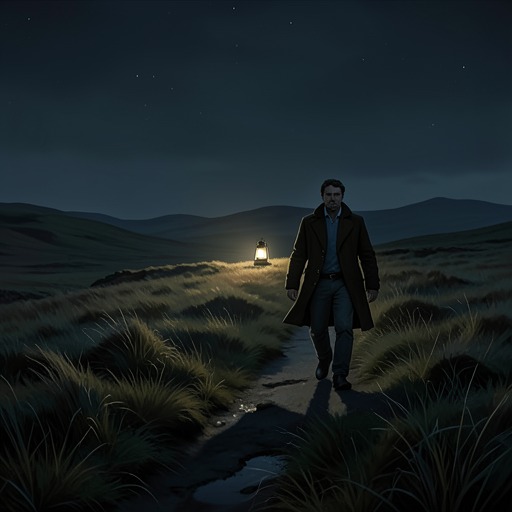
On Michaelmas, while the young woman’s father and brothers are away, Hugo and five or six companions take her from the farm to Baskerville Hall. She is kept in an upper room while the men continue their revelry below. The account emphasizes the contrast between her fear and the disorder of the gathering, but also her resourcefulness: using ivy that covers the south wall, she climbs down from beneath the eaves and sets out for home, three leagues away across the moor.
Hugo discovers her escape when he goes to bring her food and drink. The manuscript describes his response as a sudden, uncontrolled fury. He calls for his mare and the hounds, gives the pack a kerchief belonging to the young woman, and rides after her. His companions first remain bewildered, then understand the danger of the pursuit and set out after him; the company eventually numbers thirteen. The detail of the kerchief makes the hounds’ role in the chase deliberate: Hugo directs them to follow the person who has fled rather than merely riding out in anger.
The Pursuit and Its Outcome
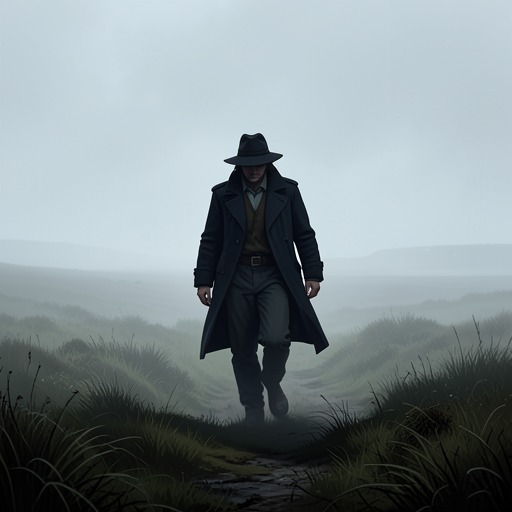
A shepherd on the moor tells the riders that he saw the young woman with the hounds behind her, and also saw Hugo pass on his black mare with a strange hound following. Soon afterward, the riders encounter the mare again, its saddle empty. The men continue, though fear has begun to divide them from the boldness of their first pursuit. They find the pack gathered at a deep hollow, reluctant to move forward.
Three riders go down into the hollow, where ancient standing stones mark an open space. There they find the young woman dead from fear and exhaustion, and Hugo lying dead nearby. The manuscript describes a large black hound standing over Hugo. The three men flee; according to the story, one dies that night from what he has seen, while the other two remain profoundly affected. The account thus gives the legend two deaths and a witness’s terror as its origin, while leaving the nature of the hound within the manuscript’s supernatural telling.
Family Memory and the Portrait
The manuscript does more than recount the deaths: it interprets them. Its author warns Hugo’s sons that the family has suffered from the passions associated with their ancestor, but also insists that the past need not determine the future. The tale invokes repentance and divine mercy alongside its caution against crossing the moor in the dark. Its final counsel turns the frightening story into a rule of conduct, while its claim that the family has endured sudden and mysterious deaths keeps the legend alive as a source of apprehension.
Centuries later, Sherlock Holmes identifies Hugo in a family portrait as the originator of the hound story. The portrait bears a name and the date 1647 on its back. Holmes first remarks that the painted man looks quieter and less imposing than he had imagined; when he raises a candle and arranges his arm around the figure’s hat and hair, the face of Stapleton becomes visible in the likeness. Holmes treats the resemblance as evidence that Stapleton belongs to the Baskerville family, and connects that discovery to his designs on the succession. The portrait gives the old account a new consequence: Hugo’s image is not merely an illustration of family lore but a clue to the identity and ambitions of a later descendant.
The Legend’s Later Use
Holmes’s reconstruction establishes that Stapleton knew the family legend and that Sir Charles Baskerville had told it to him. Sir Charles was weak-hearted and took the story seriously; Holmes concludes that Stapleton recognized how the legend could make a death appear to have a supernatural cause and impede the identification of a human murderer. Hugo’s actions therefore reach forward in a form he could not have intended: the story of his pursuit, preserved as a warning, becomes material for another man’s deception.
Hugo’s significance rests on this double inheritance. In the family manuscript, he is a warning against repeating cruelty and a figure whose story is meant to be known without being allowed to govern the future. In the later investigation, however, the continued force of that story makes it useful to Stapleton. The legend survives not simply because it is frightening, but because successive Baskervilles and their neighbors treat it as an explanation for danger on the moor—and because a calculating descendant understands how to turn that belief to his advantage.